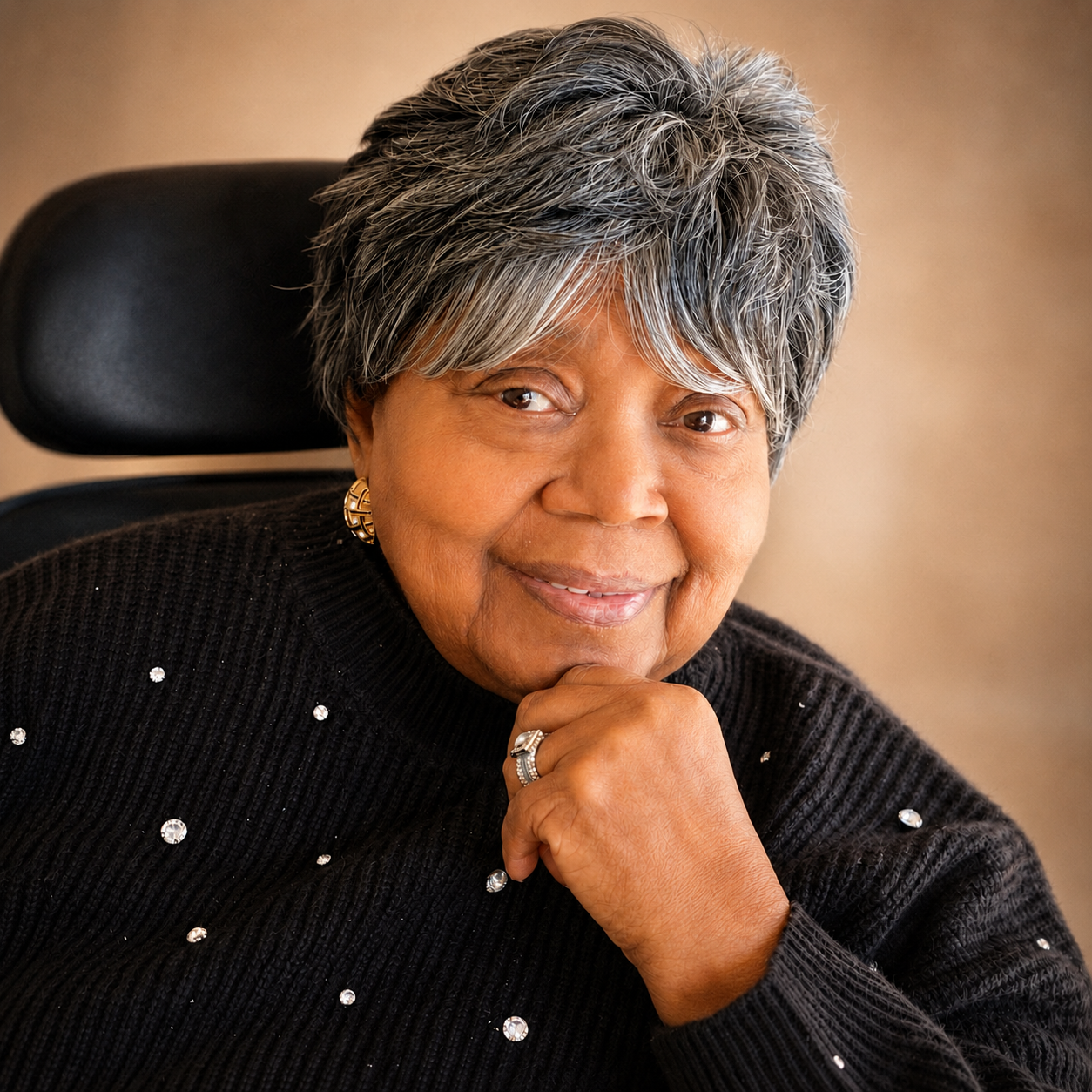
Stand with Princetta Rudd Newman on Greenwood Avenue and an empty lot rarely stays empty for long. She can tell you what stood there, who ran it, what happened in 1921, what came back afterward, and what was lost again when urban renewal and highway construction changed North Tulsa.
Princetta is Tulsa's longest-running Black Wall Street tour guide, a descendant of Greenwood business owners, and a first-generation descendant of survivors of the 1921 Tulsa Race Massacre. Her family has been in Tulsa for four generations. But guiding is only one part of a life that has included teaching, journalism, theater, fashion, printing, publishing, business, civic work, and nearly sixty years of sharing Greenwood with other people.
1956
Family
Princetta was born in Chicago and came to Tulsa in 1956, when she was eleven. Her mother, Marie Rudd Cloman, had married John A. Cloman Sr. in Chicago. John operated J.A. Cloman Realty Company from 301 North Greenwood Avenue, and he and Marie owned Service Cab, Inc. Marie was an accomplished tailor who sewed professionally and later ran Skyline Fabrics, a North Tulsa craft shop. John's mother, Bettie Pierce, was a teacher who also owned and operated a rooming house.
John's sister, Eunice Cloman Jackson, married S.M. Jackson, who had entered Greenwood's funeral business in 1917. S.M. and Eunice survived the 1921 Tulsa Race Massacre and later established Jack's Memory Chapel in 1948. John eventually became a partner in the funeral business as well. Jack's Memory Chapel is still serving Tulsa today.
Princetta grew up with a clear example of what business could do. Her family provided housing, transportation, clothing, and funeral service — businesses that were also services people depended on, supporting families, creating work, and giving their owners a way to answer needs in the community.
Her father carried that sense of responsibility into politics. John Cloman Jr. helped organize Colored Voters of America, Inc. and worked to increase Black political participation in Tulsa. He corresponded with Martin Luther King Jr. and invited King to Tulsa.
John Cloman Jr. and Eunice Jackson, Princetta's father and auntPrincetta's father, John Cloman Jr., with his sister, Princetta's aunt Eunice Jackson.
Newman donates her father's letter from KingThe Cloman family's letter from Dr. King entered the Greenwood Rising's permanent collection.Tulsa World
Education & the Arts
Princetta graduated from Booker T. Washington High School in 1962 and went on to Northeastern State University, where she studied speech and drama. She was one of a small number of Black students on campus, and Gertie B. Crawford, the respected Booker T. Washington educator, had encouraged her to be part of the university's integration. Princetta led the campus drama fraternity, graduated in May 1966, and returned to Tulsa that fall to teach English at Booker T. Washington, her alma mater. She later taught at Will Rogers High School as Tulsa began integrating its teaching staff.
The arts and fashion were part of Princetta's life from the beginning. She acted, directed theater, sang, designed costumes, and loved literature. She later trained under Freda D. Knight, Ebony magazine's first fashion commentator, and spent years behind the microphone narrating fashion shows for Tulsa's Black churches, clubs, sororities, and civic organizations.
Princetta Rudd, as a young womanA studio portrait from her years teaching and performing in Tulsa.
Y-Teens, Booker T. Washington High SchoolPrincetta Rudd served as sponsor of the Y-Teens during her years teaching at her alma mater.
Drama fraternity, Northeastern State UniversityPrincetta Rudd led the campus drama fraternity while studying speech and drama at Northeastern State.
A First for Tulsa Radio
That work led to an unexpected turn. Princetta went to KRMG Radio to promote her mother's business, Skyline Fabrics, and came away with a job. In 1970, KRMG hired her as part of Tulsa's first integrated radio news staff, making her the first Black reporter in Tulsa radio news. The station was then a 50,000-watt operation with a reach far beyond the city. Princetta's beat covered the Tulsa City Commission, county government, the Office of Community Relations Commission, the Hungry Club, downtown Rotary, and other parts of the city's civic life. She interviewed Jesse Owens, Ray Charles, and former Supreme Court Justice Arthur Goldberg, and represented the station during Pat Nixon's visit to Tulsa.
Princetta Rudd Cited With Top News TeamCoverage of the young reporter's award-winning work on KRMG's integrated news staff.The Oklahoma Eagle, July 29, 1971
Entrepreneurship
After leaving KRMG, Princetta went into business for herself. She developed the Princetta Collection, designing clothing for full-figured women and taking the line to conventions around the country. She later opened United Printing on Greenwood, published and edited General News, created Bingo Lingo, a statewide bingo newspaper, and worked in public relations and communications.
United Printing brought her into daily contact with the records of Black Tulsa. Funeral homes, churches, clubs, businesses, families, and community groups came to her for printing, bringing photographs, names, programs, and family histories with them. Over time, many of those materials were entrusted to her. Princetta's collection now includes more than 1,500 photographs and other historical materials. A funeral program she prepared in 1999 for North Tulsa businessman LeRoy Gibbs is now held by the Smithsonian National Museum of African American History and Culture.
Community & Civic Life
Printing was only one way Princetta stayed involved in the life of North Tulsa. She is a lifelong member of the NAACP and a member of Alpha Kappa Alpha Sorority, Inc. Princetta chaired the Tulsa YWCA board for eight years and later served as vice chair of its Committee on Administration. In those roles, she advocated for North Tulsa women and girls to have the same level of resources, programs, and support available elsewhere in the city. She worked with young people and senior citizens, helped organize Black-history and cultural programs, and spent years leading Black-history programming at Seminole Hills Library.
Through Black Wall Street, Inc., Princetta produced programs centered on North Tulsa's businesses, food, culture, and history. Angel Bridge honored North Tulsa women. Other programs used food, business, and community traditions to tell stories that did not always appear in formal histories. She understood that the life of a community could be found in what people cooked, wore, printed, sold, built, and passed down.
Health fair to highlight golden daysCoverage of SHARE Golden Days, the health fair Princetta organized through Black Wall Street, Inc.Oklahoma Eagle, 2005
Notable Company
Her work also put her in the company of people who came through Tulsa and needed someone who knew the city. She hosted and escorted notable figures including A.G. Gaston and Thurgood Marshall. She helped bring Satchel Paige and other Negro League veterans together in Tulsa.
In 1972, Joe Jackson and the Jackson 5 visited S.M. Jackson, their granduncle, in Tulsa. Princetta took a family photograph during the visit that shows a young Michael Jackson outside with relatives. It is the only known photograph documenting the Jackson family's connection to Greenwood and is now part of the Princetta R. Newman Collection of Family Photographs at the Smithsonian's National Museum of African American History and Culture.
Years later, attorney Johnnie Cochran came to Tulsa as part of the legal effort seeking justice for survivors and descendants of the 1921 massacre. Princetta gave him a Black Wall Street lapel pin.
She was later told that Cochran was buried wearing it.
Princetta pins Johnnie CochranPrincetta gives attorney Johnnie Cochran a Black Wall Street lapel pin during his visit to Tulsa.
Black Wall Street Tours
Princetta has been taking visitors through Greenwood since the 1966. By 1998, she had shaped that work into the guided tours that became Black Wall Street Tours. Her printing, community work, and tours overlapped, giving her a body of photographs, family histories, oral histories, business records, and personal knowledge to draw from as she showed people the district.
Her theater background became part of the tours as well. Princetta developed historical-character presentations in which actors portrayed real Greenwood and North Tulsa residents — at one point, seventeen characters. She wanted visitors to know the business owners, teachers, doctors, lawyers, funeral directors, restaurateurs, and families whose lives made Greenwood a community, not only what happened to them in 1921.
Black Wall Street & Greenwood AvenueThe intersection Princetta has guided visitors through for more than sixty years.
A living history tour, told by 15 charactersCoverage of the costumed cast Princetta assembled to bring Greenwood's history to life.Oklahoma Eagle, 2005
Princetta is a first-generation descendant of massacre survivors, but she has never treated the massacre as the whole of Greenwood's story. She talks about what people built before 1921, what they rebuilt afterward, the decades of business and community life that followed, and the changes brought later by integration, urban renewal, redevelopment, and highway construction. She wants people to understand what happened in 1921, but also Greenwood's comeback and the decades in which it continued to thrive.
Still Going
Her civic work continued alongside everything else. In 1990, Princetta ran for Tulsa County Commissioner, challenging an incumbent she believed had stopped answering to North Tulsa. In 2009, when Barack Obama was inaugurated as the first Black president of the United States, she helped organize a full day at the Greenwood Cultural Center for more than 400 Tulsa students. They watched the inauguration together, took part in a business fair, and returned that evening for a coronation ball.
A local bash for a national momentCoverage of the Greenwood Cultural Center inauguration-day program Princetta helped organize for Tulsa students.
A portion of Princetta's family photographs is now held by the Smithsonian's National Museum of African American History and Culture as the Princetta R. Newman Collection of Family Photographs. Her photographs and knowledge have also contributed to exhibitions, publications, films, research, and art projects. Much more of the collection remains in her care.
Now in her senior years, Princetta is still doing the work. She gives tours and presentations, answers questions from families and researchers, identifies people in old photographs, and works with writers and filmmakers who want to understand Greenwood more fully.
She is working on a photobook series called If These Bricks Could Talk and working with kinkofa to launch the Black Wall Street Archive, which will preserve more of the photographs, records, oral histories, and family materials she has gathered over the years.
A mural, on the Pathway to HopePrincetta's portrait is part of Doorways to Hope, the Elgin Avenue underpass installation on Tulsa's Pathway to Hope Public Art Trail honoring North Tulsa community members.
One instruction from her uncle has stayed with her:
Find a hole and fill it.
Princetta is still doing that.
Hear the rest of it walking the streets she's talking about.